Motivation: Implicants
- Finding implicants allow us to find the lowest-cost implementation
Definitions: Implicants
- Literal: Each appearance of a variable - complemented or uncomplemented - is called a literal
- E.g. has 2 literals
- Implicant: If function takes value 1 whenever product term is , so that “implies” , then is an implicant of
- Prime Implicant: An implicant is a prime implicant which forms the largest group possible to cover 1s
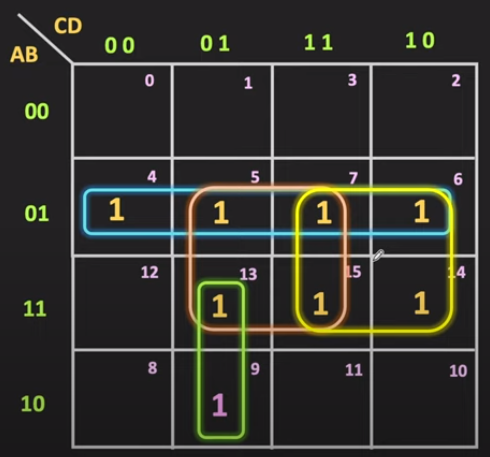
- In the below image, there are 4 prime implicants. If a group has not been circled, the cells it’s covering can already be covered by a larger group
- Cover: A cover is a set of implicants which account for all valuations (?) for which a given function
- Different sets of coverts exist for most functions
- E.g. The set of minterms for which is a cover
- E.g. The set of prime implicants is a cover
- For the example function given below, valid covers include
- Different sets of coverts exist for most functions
- Essential Prime Implicant: Essential Prime Implicants are prime implicants which cover an output value 1 that no combination of other prime implicants can cover
- In the example below, is an essential prime implicant, as it is the only prime implicant that covers
- Cost: Number of gates + Number of inputs to all gates
- Note that complemented input variables/literals are always available free ot charge. However, NOT gates will cost extra
Example: Implicants
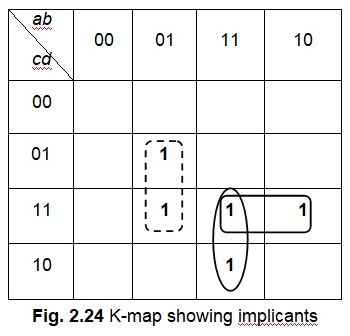
The k-map below is the SOP implementation of the function
Note that is a prime implicant; if we were to remove variable , the remaining term would form a 2x2 square in the centre of the k-map. This square would include the minterm , which has a value of 0, and thus does not imply .
Procedure: Minimisation
The procedure for creating a minimal-cost function is the following:
- Find all prime implicants (largest grouping possible covering 1s) for
- Find essential prime implicants (has “exclusive” access to a minterm) for
- If the set of essential prime implicants cover all cells for which , this SOP set is the minimal-cost cover for . If there are still “straggler” cells which are not covered, find the largest non-essential prime implicants that can be added to complete the cover
Example: Minimisation
